
What Is the ROI on Solar in Alberta?
If you are considering solar, there is a good chance one of your first questions will be some version of this: How long until I get my money back?
It is a fair question, and it is also one of the harder questions to answer responsibly. Based on the residential systems we design and what we have seen here in Alberta, a simple solar payback somewhere in the range of seven to thirteen years is a reasonable place to start. Many of the projects we see tend to land closer to eight or nine years. But that is a range, not a promise.
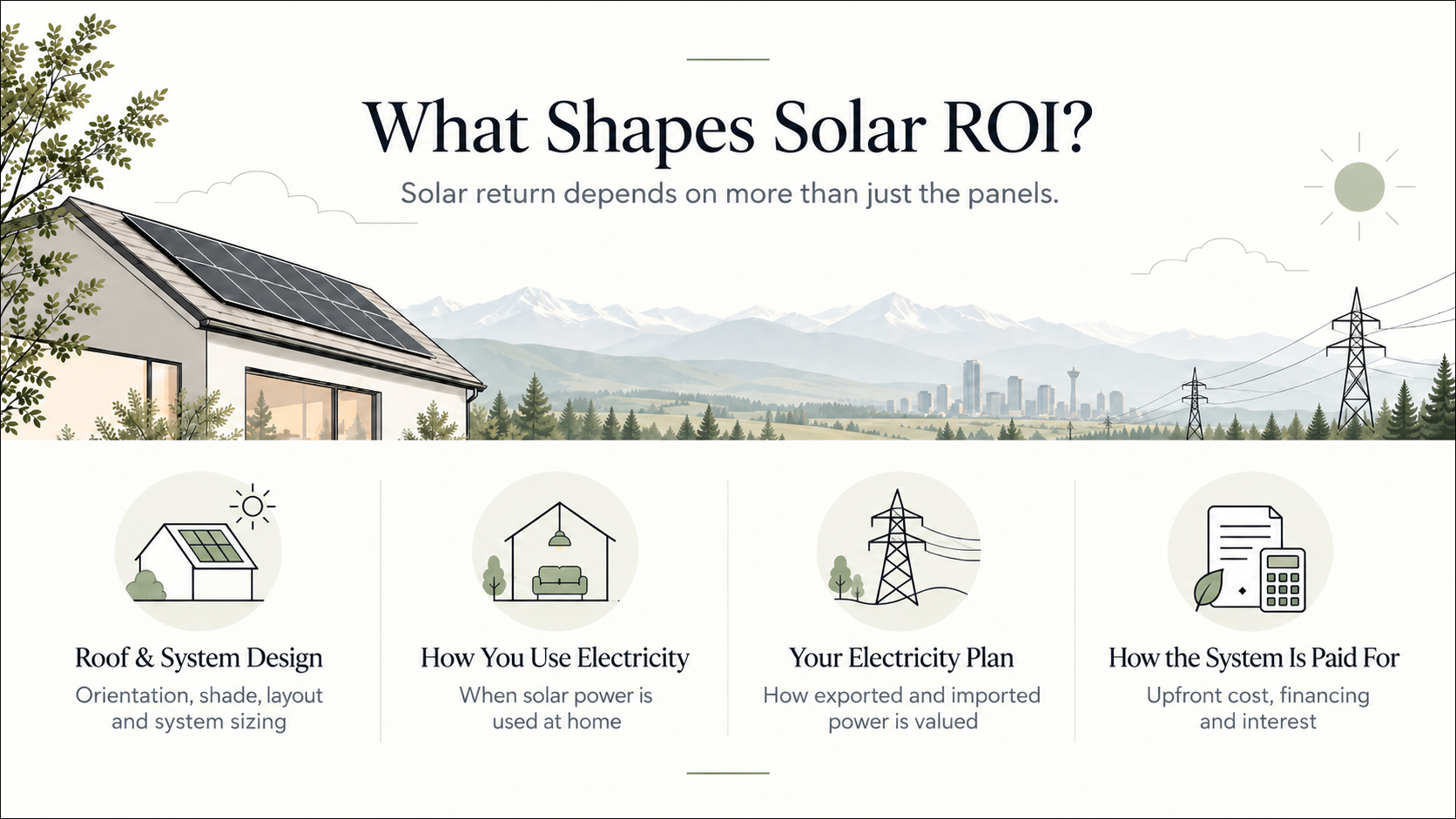
If someone can look at your address, enter a few numbers into a calculator and confidently tell you that your solar system will pay for itself in exactly 8.37 years, there are quite a few assumptions hiding behind that decimal point. Your roof matters. Your electricity use matters. When you use that electricity matters. Your retailer matters. How you pay for the system matters. Electricity rates will change over time, although nobody can tell you exactly how. The weather gets a vote too.
None of this means solar ROI cannot be estimated. We estimate it when we design systems. It simply means homeowners should understand what sits behind the number before treating it as fact.
A precise payback number can look reassuring. It can also hide a lot of assumptions.
What do we actually mean when we talk about solar ROI?
When most homeowners ask about ROI, what they are really asking about is the payback period. In simple terms, how many years will it take for the financial value created by the solar system to catch up with what the system cost? That value can come from a few places. Your panels produce electricity that you would otherwise have purchased from the grid. When the system produces more than the home is using, that excess electricity can be exported and credited through your electricity retailer. If you finance the project, the conversation changes again because you are comparing those benefits with payments and financing costs spread over time.
Technically, return on investment and payback period are different financial measurements, but homeowners understandably tend to use the terms interchangeably. For this conversation, the more useful question is simply: when does the system financially catch up with what you put into it?
On paper, the calculation seems easy enough. Take the cost of the solar system, estimate how much value it creates each year, and count forward until the two numbers meet. The trouble is that real homes tend to make spreadsheets more interesting. Your electricity use probably will not remain exactly the same for the next twenty years. You might buy an EV, add air conditioning or install a hot tub. Kids grow up, people work from home, appliances change, and somehow there is always one person in the family who believes every light in the house should be on at the same time.
Electricity rates and retailer programs can change as well. Even solar production will vary somewhat from one year to the next depending on weather and other conditions. This is why we are comfortable modelling a realistic range based on what we know today. We are much less comfortable pretending we know exactly what your electricity bill will look like in 2036.
How you use electricity can change the result
This is one of the parts of solar ROI that is easy to miss. Two homeowners could have solar systems that produce the same amount of electricity over the course of a year and still see different financial results. The difference can come down to what happens to that electricity after it is produced.
When your panels are generating power and your home needs electricity at the same time, that solar energy can be used directly by the house. When the system produces more than you need, the excess goes back to the grid and you receive a credit from your retailer. Later, when the panels are not producing enough, you import electricity from the grid again. That distinction matters because an Alberta electricity bill is not made up of a single charge for electricity. There are energy charges along with transmission, distribution and other fees. Solar can reduce a meaningful portion of what you purchase from the grid, but it does not simply make every line on the bill disappear.
EV charging is a useful example. If the vehicle is sitting at home on a sunny afternoon, there is an opportunity to charge it while the solar system is producing. Charge that same vehicle late at night and the electricity has to come from the grid instead. The solar system may have produced exactly the same amount that day, but the way the household used electricity changed the financial result.
You do not need to start planning laundry around the position of the sun or checking your solar app while everyone else is trying to enjoy dinner. But if getting the strongest possible return matters to you, understanding your consumption gives you more control. This is also why we value systems that allow homeowners to see both production and consumption. Knowing how much electricity the roof produced today is useful. Being able to see how much the home consumed at the same time gives you a much clearer picture of what the system is actually doing for you.
Some homeowners will find that fascinating and check the app every day. Others will open it twice, decide everything looks fine and forget the password. Both are perfectly reasonable.
In Alberta, your electricity retailer matters too
This is one of the more interesting parts of the ROI conversation in Alberta because our electricity market gives solar homeowners choices that can materially affect the value of the energy they export. Programs designed for solar microgenerators can allow homeowners to take advantage of different electricity rates depending on whether they are generally exporting more electricity than they are importing. The Solar Club is a familiar example, allowing solar homeowners to make better use of periods when their system is producing significant excess energy.
That can matter quite a bit in Alberta because solar production is heavily weighted toward our brighter months. Our long spring and summer days can create periods where a properly sized system produces considerably more electricity than the home is using. Winter, unsurprisingly, is another story. When reviewing actual Alberta solar production, we regularly see just how much of the annual opportunity is concentrated into those stronger months. That is why the electricity plan you choose after the panels go on the roof deserves to be part of the ROI conversation, not an afterthought.
It is also why taking somebody else's solar payback number and applying it to your house is not particularly useful. A homeowner with enough roof space to offset most of their annual electricity use, strong summer exports and a suitable electricity plan may see a very different result from someone whose roof only allows a smaller system. The panels could be identical. The financial outcome does not have to be.
Solar ROI is not only about how much electricity the panels produce. It is also about what happens to that electricity once they produce it.
Before the spreadsheet, there is the roof
There is a temptation when talking about solar ROI to go straight to electricity rates, projected savings and twenty year graphs. In reality, some of the most important decisions happen before any of that. First, the home has to be suitable for solar.
A large roof with strong exposure gives us more options. A complicated roof with shade, limited usable space or several different roof planes may still be a good solar candidate, but the design has to account for those conditions. Installation complexity can increase cost, while orientation and shading can reduce production. Both sides of that equation influence how quickly the investment pays back.
This is where the design work matters. We use detailed solar modelling to evaluate roof geometry, orientation, shading and panel placement before finalizing a system. The objective is not simply to see how many panels we can physically fit onto a roof. It is to work out where those panels will produce well and what size of system makes sense for the home's actual electricity use. A panel squeezed onto a poor section of roof because there happened to be enough space is not necessarily doing the homeowner any favours. Each part of the design should have a reason for being there.
Production modelling then gives us an estimate of how the finished system should perform over the course of a year. That estimate is incredibly useful, but it is still an estimate. Weather changes. Wildfire smoke happens. Trees grow or get trimmed. Snow conditions differ from one winter to another. We have also seen completed systems produce more electricity than their original annual model predicted, which is obviously the direction we prefer the surprise to go.
Good modelling gives us a strong foundation. We just do not confuse a well informed forecast with a crystal ball.
How you pay for the system changes the conversation
Financing is another reason two homeowners with very similar solar systems can talk about ROI differently. If you purchase a system outright, traditional payback is fairly easy to understand. You have an upfront investment and then compare it with the value the system generates over time. Financing adds interest and spreads the cost across a longer period, so the total amount paid for the system changes.
At the same time, financing introduces another useful question: what does the project do to your monthly cash flow?
St. Albert's Clean Energy Improvement Program is a good example. CEIP allows eligible homeowners to finance qualifying energy improvements, including solar, and repay the project through their property tax bill. For homeowners considering a larger solar installation, this can change the conversation considerably because they do not necessarily need to fund the entire project upfront.
A homeowner using low interest financing may therefore look at the project differently. Instead of asking only how many years it takes to recover a large payment made on day one, they may also compare the ongoing cost of financing the solar system with the electricity expense the system is helping reduce. That does not mean the system magically paid for itself the moment the panels went on the roof. Interest still counts, and the total project economics still matter. It simply means payback period and monthly cash flow are not the same question.
This is worth understanding when comparing solar proposals. A low monthly payment can be attractive, but it should not distract from the total financed cost. On the other hand, focusing only on the upfront price can overlook the opportunity that affordable financing can create. There is no need to make the math mysterious. Just make sure you know which math you are looking at.
Where solar ROI calculations can get a little too confident
This is probably the part we are most cautious about. Any calculation that tries to tell you exactly how much a solar system will save over twenty or twenty five years has to make assumptions about the future. There is no way around it.
What will electricity cost in five years? What about fifteen? Will your household still use the same amount of power? Will you add an EV? How much electricity will you consume directly and how much will you export? Which retailer will you be with? What will their rates look like? Will today's solar programs operate exactly the same way ten years from now?
Nobody knows all of those answers. Spreadsheets, unfortunately, have never been particularly bothered by uncertainty.
Give one an assumed annual electricity price increase and it will happily extend that number twenty years into the future. Change the assumption slightly and the projected return changes with it. The same thing happens with assumptions about solar exports, household consumption and future electricity rates. That does not make financial modelling useless. It means the assumptions should be visible.
This is why we prefer to focus on what can reasonably be estimated instead of giving a homeowner a savings number that looks definitive but relies heavily on things neither of us can know today. We can model the roof, estimate annual solar production, look at your historical electricity consumption and show you current electricity rates and programs. Those are useful numbers. Predicting your exact electricity bill in 2037 is where our abilities become considerably less impressive.
A good solar proposal should be confident about what can be modelled and honest about what cannot.
So, what is a realistic solar ROI in Alberta?
For the residential projects we see, seven to thirteen years remains a useful range to have in mind, with many systems landing somewhere around the middle of it. It gives homeowners a reasonable starting point without pretending every roof, household and electricity bill behaves in exactly the same way.
There will be exceptions. A very favourable property or unusually low project cost could perform better. A difficult installation, poor solar exposure, higher financing costs or a system that cannot offset much of the home's electricity use can push payback in the other direction. That is precisely why the design and the assumptions behind the proposal matter as much as the headline ROI number.
We also think it is useful to ask yourself what you actually want that number to tell you. If somebody says the payback is eight years, is eight good? Would seven change the decision? Would ten? There is not one universal number where solar suddenly becomes a sensible investment for every homeowner.
For some people the goal is purely financial. Others like the idea of producing more of their own electricity, reducing their exposure to future electricity costs, preparing for an EV or investing in something that will remain on the home for decades. Those considerations do not mean the financial return should be ignored. They simply explain why ROI is only one part of the decision.
At Prestige Electric, we believe solar can be a very good investment when the home and the numbers support it. We also do not think our job is to find a way to make every solar proposal look attractive. Our job is to model the property carefully, show you what we believe the system can produce, explain what can affect the economics and give you enough information to decide whether it makes sense.
You can estimate solar ROI before installing the system. You can design for a strong result and make smart decisions about consumption, electricity plans and financing. What you cannot do is know every variable that will affect the next twenty years with perfect accuracy.
That might not be as satisfying as a calculator flashing 8.37 years onto the screen.
It is a much more honest place to start.
Ready to look at your own solar numbers?
Solar payback depends on the property just as much as the panels. Roof layout, electricity use, system size, retailer plan and financing all shape the result, which is why a generic ROI calculator can only take you so far.
If you’re still exploring the idea, our Solar Quiz is a good place to start, or you can use our Solar Price Guide to get a better sense of potential costs. If you want to see what solar could realistically look like for your own home, we can look at your roof, historical electricity use and solar potential and model a system around the property.
The goal is to give you enough information to make the decision with your eyes open. You’ll see what we can confidently model, what assumptions are involved and what those numbers mean for your home.
And if the numbers tell us solar doesn’t make sense, we’ll tell you that too.
Prefer to speak directly to one of our experts?
Whether you want to book a solar consultation our team is here to help:
Give us a call: YEG (780) 203-8377 | CGY (403) 748-0100
Send us a email: [email protected]